


How Low-Code, Agile & Cloud Create Faster Software Velocity
Executive Summary
Enterprises have spent the last decade knee-deep in digital transformation initiatives. They’ve modernized systems, migrated workloads, and adapted to new frameworks. Yet most CIOs and CTOs still face the core friction point: delivery speed.
In a market where expectations shift rapidly and threats surface instantly, speed is no longer a “nice-to-have.” It’s the lifeblood; the currency of competitive advantage. And the few who consistently achieve — and ace — this advantage shares one common denominator: a delivery ecosystem powered by the combined strength of Low-Code, Agile, and Cloud.
Key Takeaways
- The need for speed continues to manifest in many ways for software teams. Teams still lose time to monolithic systems, manual work, and widening skill gaps.
- Low-code gives enterprises a strong lever to change this. It helps teams prototype faster, integrate quicker, automate testing, and ship with minimal engineering effort, cutting turnaround time by 50–60%.
- Agile adds discipline and predictability, enabling small, validated increments that reduce risk and tighten feedback loops.
- Cloud infrastructure unlocks instant environments, automated CI/CD, elastic scaling, and dependable architecture foundations — core essentials for software velocity.
- The breakthrough lies in combining Low-Code + Agile + Cloud, building a high-velocity delivery engine that improves time-to-market, lowers costs, accelerates innovation, and scales transformation with consistency.
What Causes Slow Software Velocity in Enterprises?
Billions of dollars are being spent on digital transformation initiatives every passing year. Still, most enterprises see sluggish delivery speeds. The root causes are systemic:
- Massive backlogs that grow faster than what teams can deliver.
- Technical debt that keeps accumulating.
- Inefficient time-to-market that stretches from weeks into months.
What Actually Kills Development Velocity?
Enterprise software velocity slows down due to monolithic architectures, manual processes, siloed teams, and widening skill gaps. These result in inflating backlogs, increasing rework, and expanding release cycles from weeks into months.
- Monolithic architectures: The outdated spread of systems resist change by design. Every modification ripples through interconnected systems, requiring extensive regression testing and coordination across multiple teams. What should take days turns into a painstaking exercise stretched into weeks.
- Manual processes: The dinosaur processes plague every stage of the software development lifecycle. Setting up environments takes days. Deployments require change review boards and weekend maintenance windows. Integration testing delays every release.
- Organization silos: Functional silos slow everything to a crawl. These walled-off corners limit visibility, restrict the flow of data, and make processes slow, bureaucratic, and complex.
Skill gaps: Organizations report that 86% struggle to find the right talent, slowing their pace of development significantly. Full-stack engineers command premium salaries, yet backlogs continue growing faster than what teams can handle.
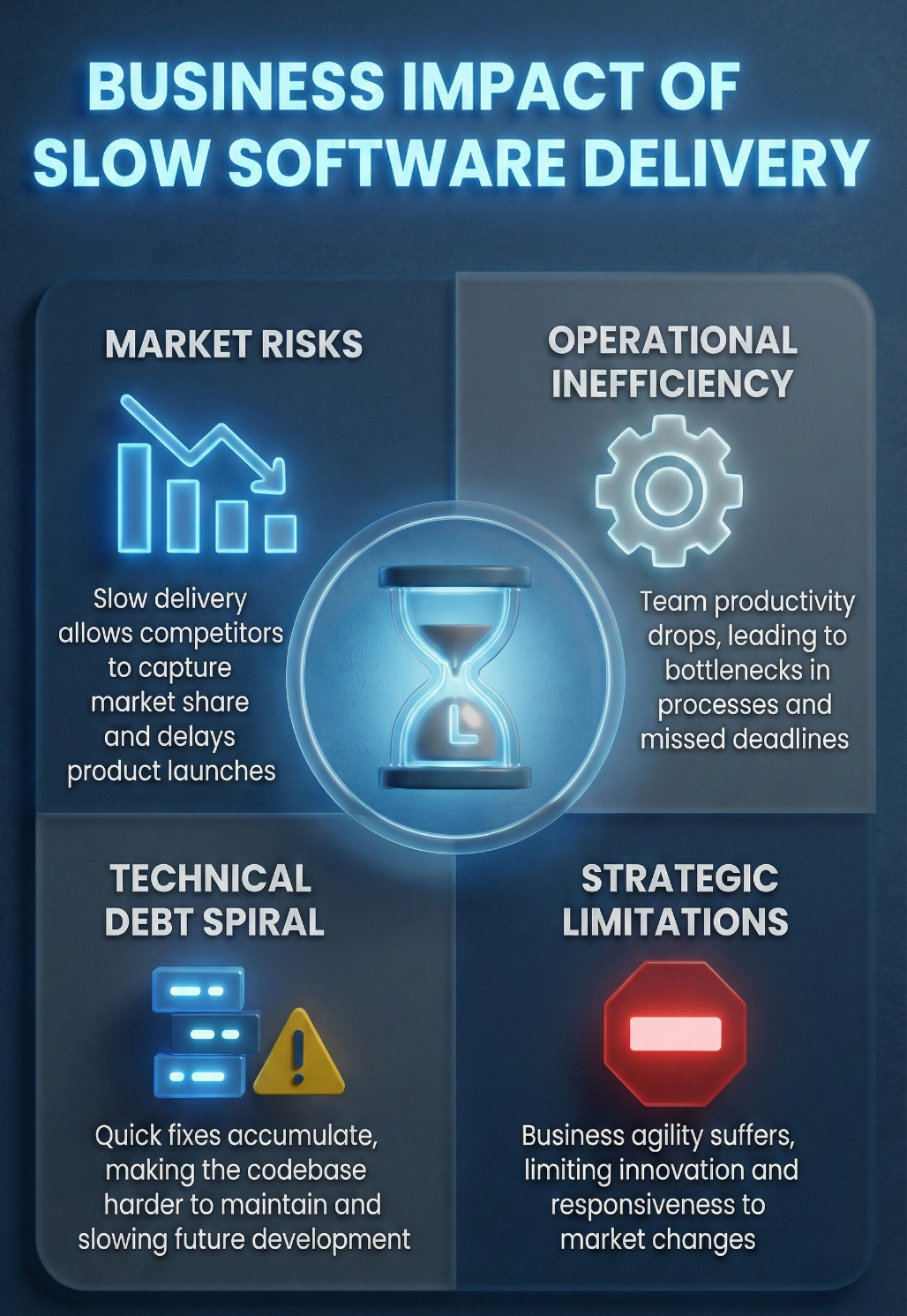
The cumulative result is predictable yet expensive: escalating development costs, slower innovation, missed market opportunities, and demoralized software development teams that feel awful watching their competitors thrive. It’s clear: slow delivery speed doesn’t just frustrate the core teams, but the organization at scale.
Need Software Delivered Fast? Infojini Builds It For You
The Triple Convergence Solution (Low-Code + Agile + Cloud)
Organizations feel intense pressure to move faster. However, they don’t just need speed. They need “sustainable speed.” The fundamental requirement isn’t acceleration; it’s a high-octane environment where modern development frameworks, in tune with cloud-native architectures, deliver 360-degree value.
Low-Code Development: Accelerating Development
Low-code development is a visual software development approach that uses drag-and-drop interfaces, reusable components, and built-in automation to build applications with minimal manual coding. It has fundamentally turned the tide for software teams, enabling developers to quickly design and build high-value systems, rather than spending their time on complex coding.
Low-code platforms address a core enterprise bottleneck: demand for software that exceeds, while engineering capacities that fail to keep up.
By allowing no-fuss access to ready-made tools, smart automation, and visual builders, they help software development teams deliver faster. This is exactly why the market for low-code platforms is growing at top speed. It’s currently headed toward $187 billion by 2030.
Low-Code Isn’t the Opposite of Pro-Code
There’s a prevalent myth around low-code development. Low-code is believed to be the opposite of pro-code, but that isn’t true. In fact, it accelerates it. By handling repetitive, monotonous tasks, it helps teams focus on advanced logic, integrations, and high-strategy priorities—everything that takes software development to a new stratosphere of innovation.
How Does Low-Code Accelerate the SDLC?
Low-code development accelerates traditional software development by attacking bottlenecks at every stage. By eliminating repetitive coding, automating testing, simplifying integrations, and enabling one-click deployment to cloud environments, it reduces build time by 50–70%.
- Prototyping at Speed: Low-code’s drag-and-drop tools make prototyping fast and intuitive. Teams can build, tweak, and test interfaces in real-time, cutting turnarounds by 70%. Stakeholders get to interact with clickable prototypes within hours and turn vision into viability.
- Designs to Production Instantly: Once the prototype is ready, low-code platforms help developers create fully-functional designs without writing a single line of manual code. Backend logic is handled visually, so teams can stay invested in solving complex problems.
- Build Swiftly With Pre-Built Components: Low-code takes the pain out of the manual build cycles by allowing teams to pull ready-to-use templates, forms, and workflows. Instead of reinventing the wheel, developers can assemble applications quickly, maintaining consistency and keeping technical debt on the lower side of the scale.
- No-Fuss Integration and Automation: Building an interconnected application ecosystem can be tedious, but not with low-code. These platforms are packed with built-in APIs and connectors that take care of every connective layer in minutes, replacing days of coding. Integrations become easier and quicker, accelerating development pipelines by over 30%.
- Smart Testing: Quality assurance becomes effortless with low-code platforms. Automated tests—powered by these platforms—check business logic, integrations, and regressions continuously. Teams catch issues early, stabilize releases, and shave 60% off traditional testing timelines.
- One-Click Deployment: Pushing updates doesn’t have to be a gamble. Low-code platforms let you deploy instantly to cloud environments with automated provisioning, monitoring, and logging. Deployment time drops by up to 90%, and teams can roll out improvements with confidence.
- Empowered Teams: Low-code development spreads the work, making developers feel empowered to take up strategic priorities faster than ever. Citizen developers contribute safely alongside IT, accelerating software velocity. Low-code development eventually opens new doorways for better collaboration, better opportunities, and better ROI.
Low-Code Development: Strategic Benefits Beyond Speed
- Addresses developer shortages
- Reduces backlog pressure
- Provides faster time-to-market
- Drives 50–70% lower TCO
Agile Methodology: The Foundation of Discipline and Software Velocity
Low-code development catalyzes software development; however, without direction, speed can unleash more losses than wins. This is where agile makes a case for itself. Agile methodologies add discipline to every cycle, creating measurable value.
What is Agile? How Does Agile Boost Software Velocity?
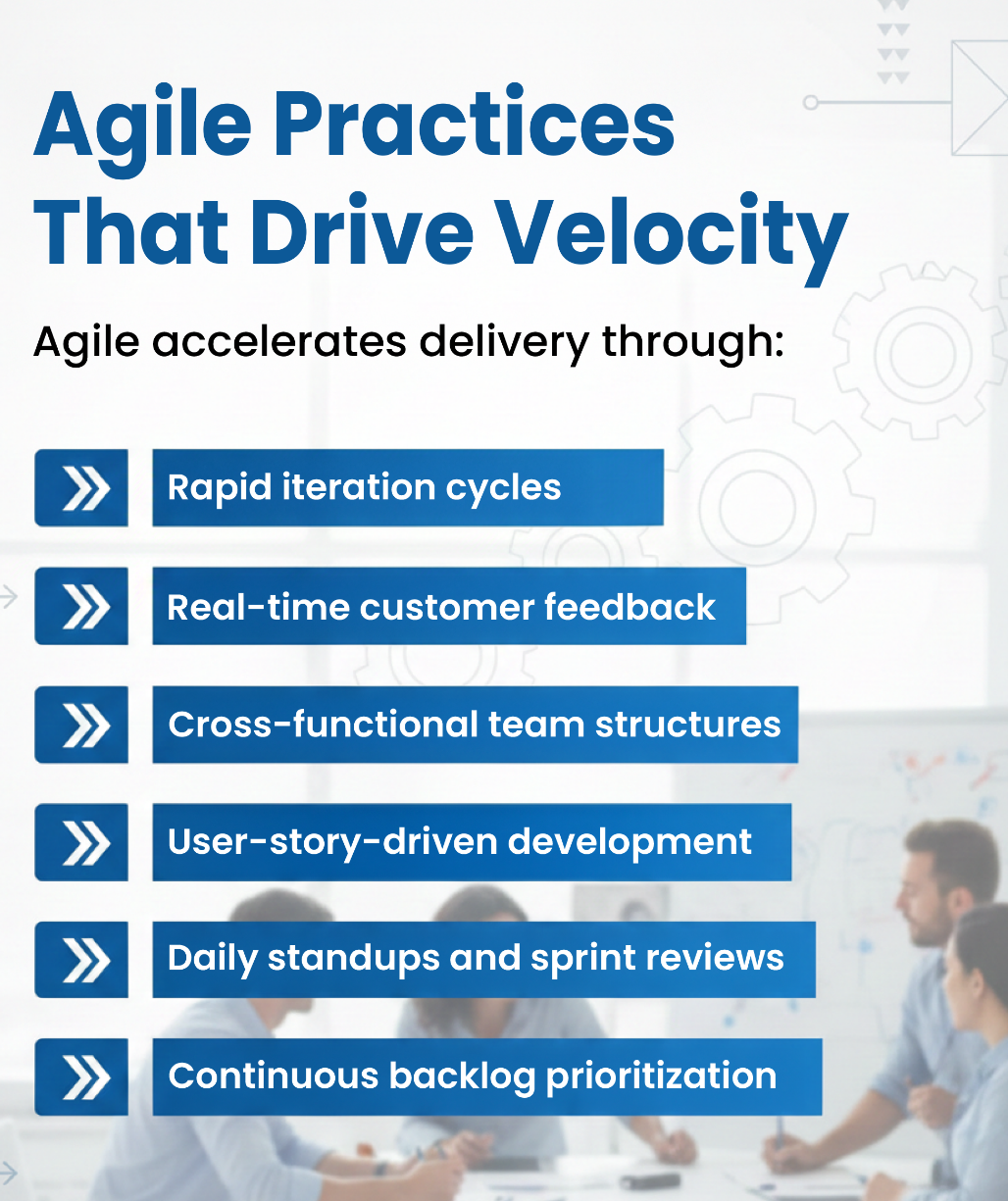
Agile is a delivery model that focuses on small, iterative releases rather than large monolithic builds. Instead of perfecting requirements and building everything before releasing, Agile creates a rhythm of continuous delivery. Small batches, rapid feedback, cross-functional collaboration, and short release cycles help teams deliver updates with speed and confidence. It removes bottlenecks across planning, prioritization, and development.
At its heart, Agile represents a shift from project-based thinking to a continuous delivery mindset. It’s rooted in three core principles:
- Iterative Development: Work happens in short cycles (usually two-week sprints) where teams plan, build, test, and ship small increments of working software. Every sprint ends with something functional, not theoretical.
- Real-World Feedback Loops: Instead of waiting months (or years) to validate assumptions, Agile teams release early and stack up insights directly from users. This ensures the product evolves with real needs, not outdated documentation.
- Continuous Improvement: Teams run regular retrospectives to evaluate what worked and what didn’t. They fine-tune processes, dismantle bottlenecks, and improve collaboration with every iteration.
Together, these components transform how software gets delivered. Agile cuts long, rigid build cycles into something more manageable and value-driven, producing solutions that align with shifting business goals. By delivering in small, validated increments, teams reduce risk, stay aligned with evolving requirements, and keep delivering value at speed.
What are the Core Agile Frameworks?
Agile methodologies get embedded into the DNA of an organization through frameworks like Scrum and Kanban. Each framework brings its own way of planning, building, and delivering software. Here’s a closer look at what each entails.
- Scrum
Scrum introduces sprint-driven development with clear roles and responsibilities. The framework structures work into fixed sprints, assigns clear roles, and uses regular ceremonies to keep teams adaptive and aligned with small, incremental goals. Scrum happens to be the most popular choice of enterprises among all kinds of Agile frameworks.
- Kanban
Kanban introduces a well-orchestrated, continuous-flow system that limits work-in-progress. It enables visibility into delivery pipelines, controls how many tasks the team handles in parallel, and improves speed by tracking metrics like cycle time, helping teams work smoothly without fixed iterations.
- SAFe (Scaled Agile Framework)
SAFe brings alignment across large organizations by coordinating roadmaps, architecture, and teams so enterprises can deliver quickly while staying strategically connected.
- Lean Software Development
Lean presents a mindset centered on waste reduction and fast learning. Lean eliminates non-value work, promotes rapid experimentation, and pushes decisions to the last responsible moment, keeping teams flexible and focused on actual value.
- XP (Extreme Programming)
This is a high-discipline framework focused on code quality and fast feedback. XP raises engineering rigor by promoting test-first development, collective code ownership, pair programming, and rapid iterations to boost reliability and responsiveness. It’s also one of the most popular Agile frameworks.
- FDD (Feature-Rich Development)
FDD blends modelling and iterative delivery, guiding teams to design, plan, and build features in short cycles, creating predictable progress and clear stakeholder visibility.
- Crystal
Crystal adapts its process based on team size, project criticality, and communication needs. It focuses on human factors (communication, team skills, and collaboration) using flexible rules that scale from small teams to larger groups while keeping agility intact.
Agile Success: How Do Agile Metrics Measure Velocity and Quality?
Agile success isn’t defined by speed alone. In fact, it’s measured by how consistently teams deliver value with quality.
Delivery performance often starts with velocity and throughput, which show how much work a team completes and how reliably they plan. Time-based metrics like cycle time, lead time, and overall time-to-market reveal how quickly an idea moves from request to real customer value.
Quality also plays a major role. Defect rates, resolution speed, technical debt levels, and automated test coverage highlight how healthy and maintainable the product truly is. Flow metrics, such as work in progress, blocked time, flow efficiency, and the size of queues, show how smoothly work moves through the system.
Ultimately, the most important measures are business outcomes: feature adoption, customer satisfaction, conversion gains, and revenue impact. These metrics confirm whether the team is building fast or building the right things.
Running Agile But Still Missing Deadlines?
Cloud: Scalability Translating Into Speed
Cloud infrastructure has a tremendous impact on software velocity. Traditional on-premise infrastructure cripples developer speed by limiting engineering capacity and slowing down every stage of delivery.
Cloud, on the flip side, breaks these barriers by introducing scalable computing resources. Teams that adopt cloud can set up environments instantly, address demand on the go, and access the tools they need without waiting for hardware or approvals. This shift lets software development teams move faster, experiment freely, and deliver software with far greater efficiency.
How Does Cloud Computing Enable Faster Software Delivery?
Cloud computing increases software velocity by enabling instant environment provisioning, automated CI/CD pipelines, elastic scaling, and self-healing infrastructure. Teams deploying on cloud release faster, recover instantly, and scale without delays.
Here’s a breakdown on how cloud boosts software velocity.
- Infrastructure That Appears on Demand
Cloud platforms eliminate the long procurement cycles that slow traditional development. Teams spin up development, testing, and production environments within minutes using APIs or consoles, backed by Infrastructure-as-Code tools like Terraform and CloudFormation. No hardware queues, no IT tickets—just instant, reproducible environments whenever teams need them.
- DevOps That Runs on Auto-Pilot
Cloud-native CI/CD pipelines accelerate the path from code commit to production. Automated builds, tests, and deployments run in environments identical to production, with blue-green and canary releases enabling zero-downtime rollouts. Rollbacks happen in seconds, and releases move from scheduled deployment windows to continuous flow.
- Elastic Capacity That Scales With Every Spike
Cloud elasticity removes capacity planning as a bottleneck. Applications automatically scale up during traffic surges and scale down when demand drops without manual intervention or overprovisioning. This elasticity lets teams experiment freely, launch in new regions instantly, and run unpredictable workloads without fear of outages or wasted spend.
- Reliability Engineered Into the Platform
Cloud architecture delivers uptime levels traditional data centers struggle to match. Multi-zone and multi-region setups, automated failover, disaster recovery, and 99.9%+ SLAs create a resilient foundation where teams keep shipping even when components fail. Reliability becomes a built-in feature, not a custom engineering burden.
- Cloud-Native Patterns That Let Teams Move Independently
Microservices, serverless functions, containers, GitOps workflows, and managed databases allow teams to deploy independently without stepping on each other’s timelines. Each service scales on its own, failures stay isolated, infrastructure heals itself, and APIs keep everything loosely coupled. When teams stop coordinating around a monolith, velocity compounds across the organization.
The Multiplier Effect: How Do Low-Code, Agile, and Cloud Increase Software Velocity?
Individually, each approach accelerates specific bottlenecks. But when combined, they work like a velocity stack. Low-code shrinks development time. Agile speeds up validation and reduces waste. Cloud eliminates infrastructure delays. Bringing out the synergy effect essentially means:
- Low-code applications that run on cloud infrastructure deploy instantly instead of waiting for environment provisioning.
- Agile sprints align perfectly with low-code’s rapid iteration. Two-week sprints become realistic when building takes days, not months.
- Cloud DevOps pipelines automate testing and deployment, enabling the continuous delivery that Agile promises but often struggles to achieve with traditional infrastructure.
This integration produces a four-layer software velocity architecture that accelerates the entire software lifecycle:
- The Experience Layer uses low-code platforms to rapidly build user interfaces, digital workflows, and customer experiences: the visible parts customers interact with daily.
- The Integration Layer connects systems through APIs, pre-built connectors, and middleware, reducing months of custom integration development.
- The Execution Layer implements Agile practices, DevOps pipelines, and CI/CD automation, ensuring rapid, reliable delivery.
- The Infrastructure Layer provides the cloud-native foundation (microservices, containers, serverless computing) that makes everything above it possible.
The quantified results are dramatic. Enterprises adopting this combined model consistently report faster time-to-market, low development costs, and improved throughput. Velocity becomes measurable, predictable, and scalable.
Implementation Roadmap by Infojini: How Can Companies Integrate Agile, Low-Code, and Cloud Together?
A successful integration of Agile methods, low-code development, and cloud infrastructure requires a phased, maturity-driven approach. The roadmap below provides a structured blueprint enterprises can adopt as a reference architecture for digital transformation programs.
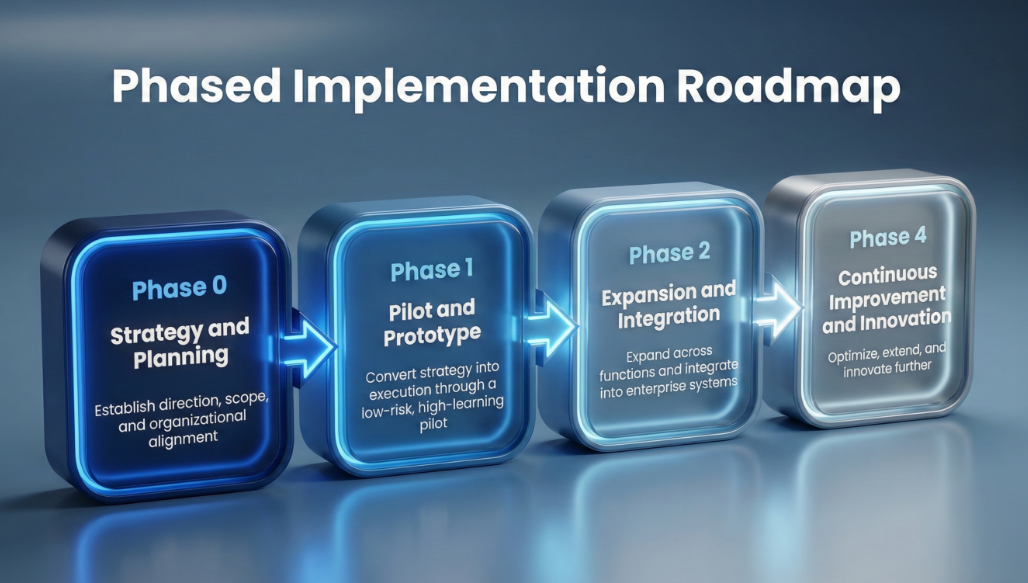
Phase 0: Strategy and Planning
This foundational phase establishes direction, scope, and organizational alignment. The objective is to clearly define the why, what, and how before execution begins.
Core Focus Areas
- Opportunity Discovery: Assess business processes and domains most suitable for digitization, automation, or modernization. Identify potential use-cases across workflows, departmental tools, and legacy systems that require replacement or revitalization.
- Governance Formation: Establish governance constructs to define roles, responsibilities, decision-making protocols, data management policies, and compliance guardrails.
- Cloud Strategy Definition: Evaluate public, private, hybrid, or multi-cloud approaches based on workload patterns, security needs, and future scalability. Select cloud providers and outline architectural constraints.
- Low-Code Platform Evaluation: Assess and shortlist low-code platforms with enterprise capabilities such as integration extensibility, scalability, security certifications, and compliance readiness.
Outcome: A clear strategy backed by governance, platform choices, cloud architecture direction, and an actionable adoption roadmap.
Phase 1: Pilot and Prototype
This phase converts strategy into execution through a low-risk, high-learning pilot initiative.
Core Focus Areas
- Pilot Execution: Develop a pilot application using low-code on cloud infrastructure. Typical candidates include departmental workflows or internal automations.
- Agile Delivery: Use short sprints (1–2 weeks) to deliver an MVP or functional prototype.
- Stakeholder Engagement: Involve business users throughout the cycle for continuous feedback and iterative refinement.
- Technical Validation: Test cloud deployment, scalability parameters, data integration, and system compatibility.
- Knowledge Capture: Document lessons, operational risks, dependency patterns, and governance refinements.
Outcome: Validated feasibility, early performance insights, and a proven model for iterative delivery.
Phase 2: Expansion and Integration
Following a successful pilot, the program expands across business functions and integrates the new delivery model into enterprise systems.
Core Focus Areas
- Use-Case Prioritization: Identify additional candidates across HR, finance, operations, CRM, supply chain, and customer-facing functions.
- Cross-Functional Delivery Teams: Form teams combining low-code developers, business SMEs, cloud engineers, QA specialists, and product owners.
- Enterprise Integration: Connect low-code outputs to ERPs, CRMs, databases, third-party APIs, and internal systems.
- DevOps Enablement: Establish CI/CD pipelines, automated testing, version control, and deployment automation for low-code assets.
- Performance Measurement: Track KPIs such as cycle time reduction, deployment frequency, user adoption, and process throughput improvements.
Outcome: Broader adoption, deeper system integration, and institutional comfort with scaled Agile-low-code-cloud delivery.
Phase 3: Governance, Standardization, and Scaling
As adoption increases, consistency and control become essential. This phase formally institutionalizes standards and practices.
Core Focus Areas
- Enterprise Standards: Define architecture guidelines, integration frameworks, naming conventions, versioning requirements, and data governance protocols.
- Center of Excellence (CoE): Establish a CoE or steering committee to maintain oversight, evaluate new capabilities, manage platform evolution, and support teams.
- Training and Enablement: Strengthen workforce capabilities with structured training for IT teams, business users, and citizen developers.
- Scaling Strategy: Plan for multi-cloud or hybrid deployments, resource optimization, disaster recovery, and full lifecycle management of low-code applications.
Outcome: Standardized delivery practices, disciplined expansion, and a governed environment supporting enterprise-scale operations.
Phase 4: Continuous Improvement and Innovation
With foundational capabilities firmly established, the organization transitions into a cycle of sustained optimization and innovation.
Core Focus Areas
- Ongoing Enhancement: Encourage development of incremental features, micro-applications, and targeted improvements across business units.
- Analytics-Driven Optimization: Use telemetry to observe performance, adoption patterns, and cost behavior, and take informed actions.
- Legacy Modernization: Identify systems suitable for migration from monolithic or legacy architectures to cloud-native and low-code solutions.
- Governance Evolution: Periodically review governance frameworks, platform policies, and compliance mechanisms to keep pace with business and regulatory changes.
- Culture Development: Reinforce a culture of collaboration, continuous feedback, lean delivery, and strong business-IT alignment.
Outcome: A self-improving ecosystem capable of sustained innovation, operational agility, and enterprise-wide digital resilience.
Turn Software Speed Into a Competitive Weapon
Conclusion: Speed as Strategy
Speed, hands-down, is a strategic advantage in a world characterized by constant change. Organizations that embrace low-code, Agile, and cloud together build systems that learn, adapt, and scale at market speed.
The winners in the next decade wouldn’t be organizations with the biggest engineering teams or the largest IT budgets. They’ll be organizations that built velocity into their operating model; that made speed a system, not an aspiration. The question is whether your organization will be among them.